This website auto-detects system light/dark mode and remembers your preferences (theme, font, width) using localStorage (no cookies).

Alex Hainen
ProfessorCivil, Construction, & Environmental Engineering
The University of Alabama
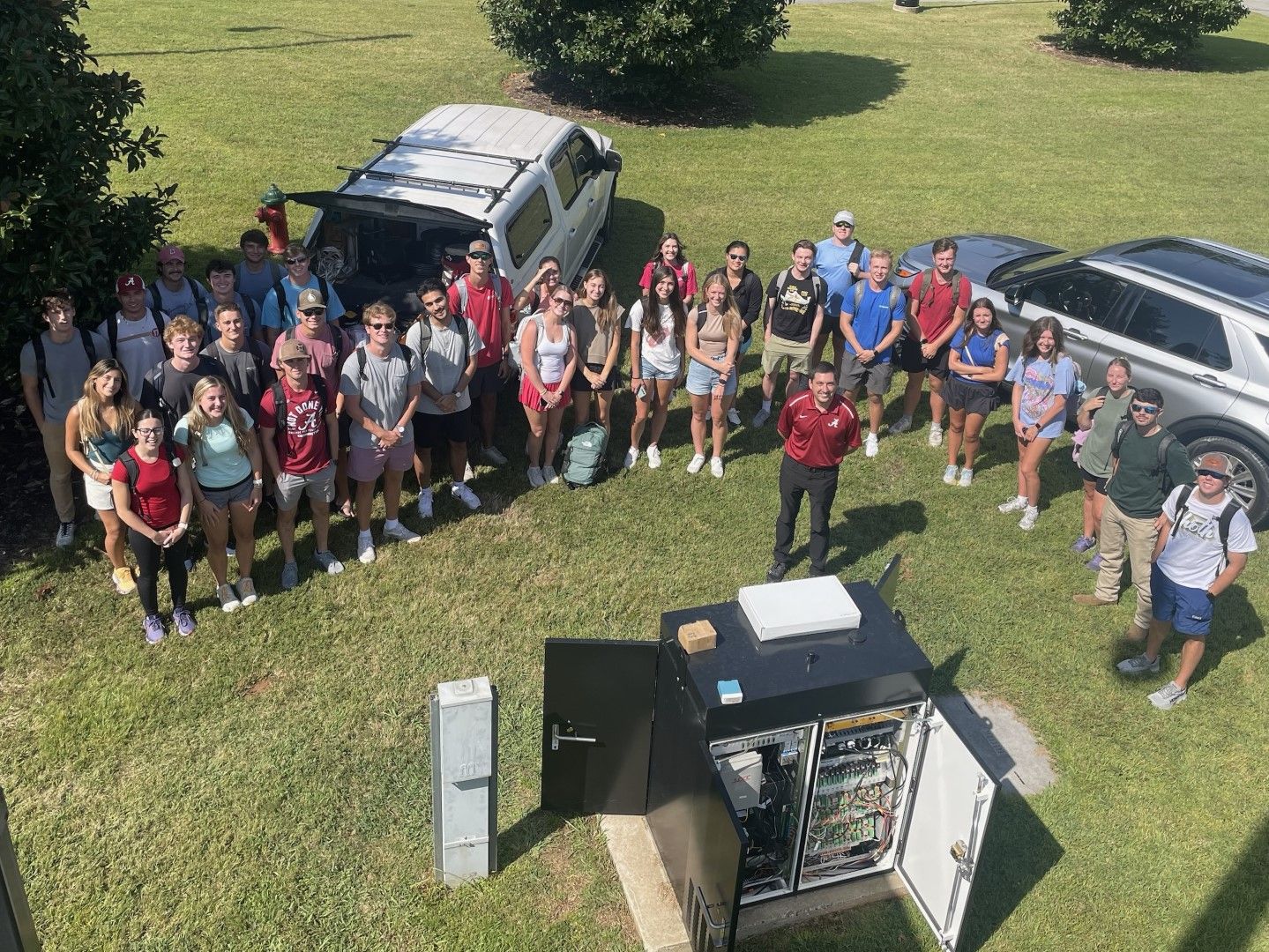
CE451 Roadway and Intersection Design Class
Welcome
Hi there, and welcome to my website! I'm a professor at UA in civil engineering. My research focuses on traffic engineering. I love what I do, and I love being at UA! Please check out my bio and other items below. Thanks, and God bless!
Biography
Dr. Alex Hainen is a professor in the Department of Civil, Construction, and Environmental Engineering (CCEE) in the College of Engineering (CoE) at The University of Alabama (UA) and serves as the director of the Center for Transportation Operations, Planning, and Safety (CTOPS). He received his BSCE from Michigan Technological University and his MSCE and PhD from Purdue University. At UA, Dr. Hainen is affiliated with the Alabama Transportation Institute (ATI), the Center for Advanced Vehicle Technology (CAVT), and the Center for Advanced Public Safety (CAPS). As an academic, Dr. Hainen has been heavily involved with planning, designing, deploying, and publishing in the areas of traffic engineering, intelligent transportation systems (ITS), transportation systems management and operation (TSMO), and connected and automated vehicles (CAVs). He has been involved with 56 transportation research and deployment projects representing more than $50 million of funded research efforts. While at The University of Alabama, Dr. Hainen has been the principal investigator on more than $24 million of these projects and deployments (including two Federal Highway Administration Advanced Traffic Congestion Management Technology Deployment efforts in partnership with the Alabama Department of Transportation). All of this work has been funded by a variety of agencies including state departments of transportation, the United States Department of Transportation (USDOT), the Federal Highway Administration (FHWA), the National Science Foundation (NSF), the United States Department of Energy (USDOE), the Federal Transit Agency (FTA), the United States Department of War (DOW) (formerly the Department of Defense) through the United States Army’s Engineering Research and Development Center (ERDC) and Construction Engineering Research Lab (CERL), and the American Automobile Association (AAA) Foundation for Traffic Safety. Dr. Hainen has worked all the way from raw sensors (cameras, radars, magnetometers, LiDARs, etc.), through raw data (high-resolution data, point could data, sensor feed data), into processed data (discrete records, operations data, safety and crash data), and ultimately into the interface or dashboard presentation to transportation engineers. He has seen the full life of ITS products and been involved from the very conception through the full and successful nationwide implementations.
Dr. Hainen’s experience continues into a strong academic background of working with colleagues, researchers, and partners around the nation and world. He has had international ITS collaborations in Europe and Asia, and has an extensive network of colleagues across the US. He has been involved with Pooled Fund Studies, National Cooperative Highway Research Program (NCHRP) projects and panels, the National Academies of Transportation Research Board (TRB) committees and subcommittees, and has worked with standards development in the traffic signal and ITS area. Dr. Hainen has worked with many states, cities, manufacturers, vendors, universities, and colleagues with his projects. Through two Transportation Pooled Fund Projects, TPF-5(258) “Traffic Signal Systems Operations and Management” and TPF-5(377) “Enhanced Traffic Signal Performance Measures,” he has worked with state DOTs from Alabama, California, Connecticut, Georgia, Indiana, Kansas, Michigan, Minnesota, Mississippi, New Hampshire, North Carolina, Ohio, Pennsylvania, Tennessee, Texas, Utah, and Wisconsin. He has been invited to talk to the 50 state traffic engineers at the American Association of State Highway and Transportation Officials (AASHTO) Committee on Traffic Engineering (COTE) and Committee on Transportation System Operations (CTSO). He works closely with nearly all traffic signal ITS manufacturers and has many deployments of the latest and most advanced traffic systems. Currently, Dr. Hainen is actively working with the Alabama Department of Transportation (ALDOT) to collect data and manage operations at 490 signalized intersections across the state of Alabama and 100 signalized intersections for the Mississippi Department of Transportation (MDOT).
Dr. Hainen’s work has led to more than 50 peer reviewed journal articles published in the Transportation Research Record, Institute of Transportation Engineers Learned Journal of Transportation, ASCE Journal of Transportation Engineering, Part A: Systems, Journal of Transportation Research Forum, Advances in Transportation Studies, Accident Analysis and Prevention, Advances in Civil Engineering, Journal of Performance of Constructed Facilities, Journal of Transport Geography, Journal of Advanced Transportation, Journal of Intelligent Transportation Systems: Technology, Planning, and Operations, and other journals. He also has more than 50 conference articles and 40 invited talks. He is an associate editor for the Journal of Modern Mobility Systems, and has served as a reviewer for the Journal of Transportation Engineering, Transportation Research Board, IEEE Intelligent Transportation Systems, and Transportation Research Part A: Policy and Practice. He has advised six PhD students, ten MSCE/MSME students, and served on 18 other PhD student dissertation committees. He also serves as vice chair on the West Alabama Regional Commission’s (WARC) Citizens Transportation Advisory Committee (CTAC), appointed by Tuscaloosa County Probate Judge Robertson in 2021.
Publications
- Hainen, A.M., J.S. Wasson, S.M.L. Hubbard, S.M. Remias, G.D. Farnsworth, and D.M. Bullock, “Estimating Route Choice and Travel Time Reliability with Field Observations of Bluetooth Probe Vehicles,” Transportation Research Record: Journal of the Transportation Research Board, No. 2256, Transportation Research Board of the National Academies, Washington, D.C., pp. 43–50, 2011. DOI: 10.3141/2256-06.
- Remias, S. S.M.L. Hubbard, E. Hulme, A. Hainen, G. Farnsworth, and D.M. Bullock, “Bias, Repeatability, and Variability of 1 Traffic Sign Retroreflectivity,” ITE Learned Journal of Transportation, Vol. 1, Issue 1, March 2011.
- Wasson, J.S., G.W. Boruff, A.M. Hainen, S.M. Remias, E.A. Hulme, G. Farnsworth, and D.M. Bullock, “Evaluation of Spatial and Temporal Speed Limit Compliance in Highway Workzones,” Transportation Research Record, No. 2258, Transportation Research Board of the National Academies, Washington, D.C., pp. 1–15, 2011. DOI: 10.3141/2258-01.
- Day, C.M., T.M. Brennan, A.M. Hainen, S.M. Remias, H. Premachandra, J.R. Sturdevant, G. Richards, J.S. Wasson, and D.M. Bullock, “Reliability, Flexibility, and Environmental Impact of Alternative Objective Functions for Arterial Offset Optimization,” Transportation Research Record, No. 2259, pp. 8–22, 2011. DOI: 10.3141/2259-02.
- Grossman, J.A., A.M. Hainen, S.M. Remias, and D.M. Bullock, “Evaluation of Thermal Image Video Sensors for Stop Bar Detection at Signalized Intersections,” Transportation Research Record, No. 2308, pp. 184–198, 2012. DOI: 10.3141/2308-20.
- Day, C.M., J.M. Ernst, T.M. Brennan, C. Chou, A.M. Hainen, S.M. Remias, A. Nichols, B.D. Griggs, and D.M. Bullock, “Performance Measures for Adaptive Signal Control: Case Study of Central System-in-the-Loop Simulation,” Transportation Research Record, No. 2311, pp. 1–15, 2012. DOI: 10.3141/2311-01.
- Brennan, T.M., B.D. Griggs, G. Grimmer, A.M. Hainen, C.M. Day, J.R. Sturdevant, and D.M. Bullock, “Defining Design Space for Parameters of Traffic Signal Timing,” Transportation Research Record, No. 2311, pp. 85–98, 2012. DOI: 10.3141/2311-08.
- Mitkey, S.R., T.M. Brennan, S.M. Remias, A.D. Davis, G.M. Grimmer, A.M. Hainen, R. Morris, P. Michael, and D.M. Bullock, “Comparison of the Retroreflective Durability Between Rumble Stripes and Painted Lines,” ITE Learned Journal of Transportation, Vol. 3, Issue 1, July 2012.
- Hainen, A.M., E.M. Rivera-Hernandez, C.M. Day, M. McBride, G.M. Grimmer, A.J. Loehr, and D.M. Bullock, “Roundabout Critical Headway Measurement based on Hi-Resolution Event-Based Data from Wireless Magnetometers,” Transportation Research Record, No. 2389, pp. 51–64, 2013. DOI: 10.3141/2389-06.
- Remias, S.M., A.M. Hainen, C.M. Day, T.M. Brennan, H. Li, E. Rivera-Hernandez, J. Sturdevant, S.E. Young, and D.M. Bullock, “Performance Characterization of Arterial Traffic Flow with Probe Vehicle Data,” Transportation Research Record, No. 2380, pp. 10–21, 2013. DOI: 10.3141/2380-02.
- Li, H., A.M. Hainen, C.M. Day, G. Grimmer, J. Sturdevant, and D.M. Bullock, “Longitudinal Performance Measures for Assessing Agency-Wide Signal Management Objectives,” Transportation Research Record, No. 2355, pp. 20–30, 2013. DOI: 10.3141/2355-03.
- Day, C.M., J. Sturdevant, H. Li, A. Stevens, A.M. Hainen, S.M. Remias, and D.M. Bullock, “Revisiting the Cycle Length–Lost Time Question With Critical Lane Analysis,” Transportation Research Record, No. 2355, pp. 1–9, 2013. DOI: 10.3141/2355-01. (TRB AHB25 Committee 2013 Best Paper Award)
- Remias, S.M., A.M. Hainen, and D.M. Bullock, “Leveraging Probe Data to Assess Security Checkpoint Wait Times,” Transportation Research Record, No. 2325, pp. 63–75, 2013. DOI: 10.3141/2325-07.
- Hainen, A.M., S.M. Remias, D.M. Bullock, and F.L. Mannering, “A hazard-based analysis of airport security transit times,” Journal of Air Transport Management, 32, 32–38, September 2013. DOI: 10.1016/j.jairtraman.2013.06.002.
- Hainen, A.M., A.L. Stevens, R.S. Freije, C.M. Day, J.R. Sturdevant, and D.M. Bullock, “High-Resolution Event-Based Data at Diamond Interchanges: Performance Measures and Optimization of Ring Displacement,” Transportation Research Record, No. 2439, pp. 12–26, Oct. 2014. DOI: 10.3141/2439-02.
- Freije, R.S., A.M. Hainen, A.L. Stevens, H. Li, W.B. Smith, H.T. Summers, C.M. Day, J.R. Sturdevant, and D.M. Bullock, “Graphical Performance Measures for Practitioners to Triage Split Failure Trouble Calls,” Transportation Research Record, No. 2439, pp. 27–40, Oct. 2014. DOI: 10.3141/2439-03.
- Lavrenz, S.M., A.M. Hainen, A.L. Stevens, C.M. Day, H. Li, R.S. Freije, W.B. Smith, H.T. Summers, J.R. Sturdevant, and D.M. Bullock, “Improving Intersection Behavior through Delay-Based Left Turn Phase Initiation,” Transportation Research Record, No. 2439, pp. 41–52, Oct. 2014. DOI: 10.3141/2439-04.
- Hainen, A.M., H. Li, A.L. Stevens, C.M. Day, J.R. Sturdevant, and D.M. Bullock, “Sequence Optimization at Signalized Diamond Interchanges Using High-Resolution Event-Based Data,” Transportation Research Record, No. 2487, pp. 15–30, Oct. 2015. DOI: 10.3141/2487-02.
- Hainen, A.M., A.L. Stevens, C.M. Day, H. Li, J. Mackey, M. Luker, M. Taylor, J.R. Sturdevant, and D.M. Bullock, “Performance Measures for Optimizing Diverging Interchanges and Outcome Assessment with Drone Video,” Transportation Research Record, No. 2487, pp. 31–43, Oct. 2015. DOI: 10.3141/2487-03.
- Lavrenz, S.M., C.M. Day, A.M. Hainen, W.B. Smith, A.L. Stevens, H. Li, and D.M. Bullock, “Use of Maximum Vehicle Delay to Characterize Signalized Intersection Performance,” Transportation Research Record, No. 2488, pp. 41–52, 2015. DOI: 10.3141/2488-05.
- Hainen, A.M., “Investigating mixed logit analysis of critical headways at a single lane instrumented roundabout,” Journal of Transportation Research Forum, 55(3), Fall 2016. DOI: 10.5399/osu/jtrf.55.3.4391.
- Lidbe, A.D., A.M. Hainen, S.L. Jones, “Analytical Techniques for Evaluating the Implementation of Adaptive Traffic Signal Control Systems,” Journal of Transportation Engineering, Part A: Systems, 143(5), 2017. DOI: 10.1061/JTEPBS.0000034.
- Lidbe, A.D., A.M. Hainen, S.L. Jones, “Comparative study of simulated annealing, tabu search, and the genetic algorithm for calibration of the microsimulation model,” SIMULATION, 93(50): 21–33, 2017. DOI: 10.1177/0037549716683028.
- Lidbe, A.D., E.G. Tedla, A.M. Hainen, A. Sullivan, S.L. Jones, “Comparative assessment of arterial operations under conventional time-of-day and adaptive traffic signal control,” Advances in Transportation Studies, Vol. 42, pp. 5–22, July 2017. Link.
- Song, S., Q. Lyu, E. Marks, and A. Hainen, “Steel Manufacturing Incident Analysis and Prediction,” Journal of Safety, Health and Environmental Research, 14(1), 2018. Link.
- Adanu, E.K., A.M. Hainen, and S.L. Jones, Jr., “Latent class analysis of factors that influence weekday and weekend single-vehicle crash severities,” Accident Analysis and Prevention, 113:187–192, 2018. https://doi.org/10.1016/j.aap.2018.01.035.
- Lidbe, A.D., E.G. Tedla, A.M. Hainen, S.L. Jones, “Feasibility Assessment for Implementing Adaptive Traffic Signal Control: A Case Study,” Journal of Transportation Engineering, Part A: Systems, accepted July 2018. https://doi.org/10.1061/JTEPBS.0000208.
- Talukder, M.A.S., A.M. Hainen, S.M. Remias, and D.M. Bullock, “Route-based mobility performance metrics using probe vehicle travel times,” Advances in Transportation Studies, 46:135–152, Nov. 2018. Link.
- Crawford, P.S., M.A. Al-Zarrad, A.J. Graettinger, A.M. Hainen, W.E. Back, and L. Powell, “Rapid Disaster Data Dissemination and Vulnerability Assessment through Synthesis of a Web-Based Extreme Event Viewer and Deep Learning,” Advances in Civil Engineering, 2018, Article ID 7258156. https://doi.org/10.1155/2018/7258156.
- Hainen, A.M., J.K. Lindly, K.B. Harbin, D.C. Dye, “Duration Analysis of Emergency Shutdown Incidents Regarding Hazardous Liquid Pipelines,” Journal of Performance of Constructed Facilities, 34(3), 2019. https://doi.org/10.1061/(ASCE)CF.1943-5509.0001364.
- Liu, J., A. Hainen, X. Li, Q. Nie, S. Nambisan, “Pedestrian injury severity in motor vehicle crashes: An integrated spatiotemporal modeling approach,” Accident Analysis and Prevention, 132:105272, 2019. https://doi.org/10.1016/j.aap.2019.105272.
- Jones, S.L., A.D. Lidbe, A.M. Hainen, “What can open access data from India tell us about road safety and sustainable development?” Journal of Transport Geography, 80:102503, 2019. https://doi.org/10.1016/j.jtrangeo.2019.102503.
- Islam, N., M.A.S. Talukder, A.M. Hainen, et al., “Characterizing co-modality in urban transit systems from a passengers’ perspective,” Public Transport, 12, 405–430, 2020. https://doi.org/10.1007/s12469-020-00228-y.
- Talukder, S., A.D. Lidbe, E.G. Tedla, A.M. Hainen, and T.L. Atkison, “Trajectory-Based Signal Control in Mixed Connected Vehicle Environments,” Journal of Transportation Engineering, Part A: Systems, 147(5), 2021. Link.
- Islam, N., A.M. Hainen, S. Burdette, R.K. Smith, “An analytical assessment of freeway service patrol on incident clearance times,” Advances in Transportation Studies, 54:75–88, 2021. Link.
- Li, X., P. Penmetsa, J. Liu, A.M. Hainen, S. Nambisan, “Severity of emergency natural gas distribution pipeline incidents: Application of an integrated spatio-temporal approach fused with text mining,” Journal of Loss Prevention in the Process Industries, 69:104383, 2021. https://doi.org/10.1016/j.jlp.2020.104383.
- Islam, N., E.K. Adanu, A.M. Hainen, S. Burdette, R. Smith, S.L. Jones, Jr., “A comparative analysis of freeway crash incident clearance time using random parameter and latent class hazard-based duration model,” Accident Analysis & Prevention, 160:106303, 2021. https://doi.org/10.1016/j.aap.2021.106303.
- Xing, F., Q. Nie, J. Liu, A. Khattak, A. Hainen, S. Nambisan, “Constructing spatiotemporal driving volatility profiles for connected and automated vehicles in existing highway networks,” Journal of Intelligent Transportation Systems, 26(5), 572–585, 2021. https://doi.org/10.1080/15472450.2021.1944133.
- Talukder, M., E. Tedla, A. Hainen, and T. Atkison, “Analytical and Empirical Evaluation of Freight Priority System in Connected Vehicle Environment,” Journal of Transportation Engineering, Part A: Systems, 148(6), 2022. https://doi.org/10.1061/JTEPBS.0000673.
- Islam, N., E.K. Adanu, A. Hainen, S. Burdette, R. Smith, S. Jones, “Evaluating the Impact of Freeway Service Patrol on Incident Clearance Times: A Spatial Transferability Test,” Journal of Advanced Transportation, 2022. https://doi.org/10.1155/2022/5272747.
- Awolusi, I., E. Marks, A. Hainen, A. Alzarrad, “Incident Analysis and Prediction of Safety Performance on Construction Sites,” CivilEng, 3, 669–686, 2022. https://doi.org/10.3390/civileng3030039.
- Zhang, Z., Q. Nie, J. Liu, A. Hainen, N. Islam, C. Yang, “Machine learning based real-time prediction of freeway crash risk using crowdsourced probe vehicle data,” Journal of Intelligent Transportation Systems, 28(1), 84–102, 2022. https://doi.org/10.1080/15472450.2022.2106564.
- Salvi, K.A., M. Kumar, and A.M. Hainen, “Sensitivity of Traffic Speed to Rainfall,” Weather, Climate, and Society, 14, 1165–1175, 2022. https://doi.org/10.1175/WCAS-D-22-0024.1.
- Poptic, S.M., P. Penmetsa, J. Liu, E. Tedla, A. Hainen, S. Nambisan, “Dedicated lanes for connected and automated vehicles on freeways: a simulation study,” Advances in Transportation Studies, 59:233–246, April 2023. Link.
- Liu, J., X. Fu, A. Hainen, C. Yang, L. Villavicencio, W.J. Horrey, “Evaluating the impacts of vehicle-mounted Variable Message Signs on passing vehicles: implications for protecting roadside incident and service personnel,” Journal of Intelligent Transportation Systems, July 2023. https://doi.org/10.1080/15472450.2023.2227968.
- Fu, X., J. Liu, Z. Huang, A. Hainen, A.J. Khattak, “LSTM-based lane change prediction using Waymo open motion dataset: The role of vehicle operating space,” Digital Transportation and Safety, 2(2):112–123, 2023. https://doi.org/10.48130/DTS-2023-0009.
- Schrader, M., A. Hainen, J. Bittle, “Extracting Vehicle Trajectories from Partially Overlapping Roadside Radar,” Sensors, 24, 4640, 2024. https://doi.org/10.3390/s24144640. (Voted best presentation #MaxSchrader by the conference attendees at the 2024 SUMO User Conference)
- Annimalla, V., A. Hainen, E. Tedla, “Analyzing Manual Traffic Control During Special Events using Signal Performance Measures Data,” Advances in Transportation Studies, 64:251–264, Nov. 2024. Link.
- Cho, N., A. Hainen, E. Tedla, S. Burdette, “A comparison of machine learning-based method vs. the Highway Capacity Manual method of intersection delay,” Advances in Transportation Studies, 65:203–220, 2025. Link.
- Okafor, S., P. Penmetsa, V. Annimalla, E. Tedla, A. Hainen, S. Jones, “A Statewide Correlation Analysis of Connected Vehicles Hard Braking Event Data and Road Traffic Crashes,” Advances in Transportation Studies, 65:239–252, 2025. Link.
- Cho, N., A. Hainen, E. Tedla, S. Burdette, “Integrating Signal Performance Data for Turning Movement Counts Estimation at Intersections Using Machine Learning,” ASCE Journal of Transportation Engineering, Part A: Systems, 151(10), 2025. https://doi.org/10.1061/JTEPBS.TEENG-858.
- Lu, W., X. Fu, J. Liu, A. Hainen, F. Xia, and O. Chen, “A ‘digital twin’ traffic simulation tool for network-wide real-time traffic monitoring and management,” Journal of Intelligent Transportation Systems, 2025. https://doi.org/10.1080/15472450.2025.2553287.
- Cho, N., A. Hainen, “Reducing Time of Day Traffic Signal Controller Transitions Through Collective Offset Adjustments,” ASCE Journal of Transportation Engineering, Part A: Systems, under final editorial review, 2025.
Teaching
I have taught the following classes at UA:
- CE350 Introduction to Transportation Engineering – This is a fun intro course for juniors. I haven’t taught the class since 2017 since I get to focus on the senior transportation electives.
- CE451/551 Roadway and Intersection Design – This is a classic transportation design course where we learn about AASHTO’s A Policy on Geometric Design of Highways and Streets. I developed a six-part lab on AutoCAD Civil 3D that has been fantastic for students. You can check out an old video of the lab here.
- CE458/558 Traffic Engineering – This is my favorite class! We go through some of the Highway Capacity Manual, but the class has a major emphasis on technology and tools. We touch on microsimulation, machine learning for cameras and LiDAR, and work on SQL big data labs. There is also a huge focus on hardware for traffic signal control. Students visit an actual traffic signal controller cabinet in the field and learn about every part. We also work on a four-part PTV Vistro lab for a signal timing design.
- CE573 Statistical Applications – This is the first of a two-part course I teach on statistics. We work through hypothesis testing and regression in chapters 8-16 of Jay Devore’s book, Probability and Statistics for Engineering and the Sciences. In a world where AI/ML is rapidly expanding, my predecessor for this course said it well: “The fundamentals never change.” In the modern era of AI/ML, there are important concepts that students need to understand.
- CE673 Statistics & Econometrics – This is another favorite course of mine, but I don’t get to teach it that often. In grad school, I was very blessed to take Prof. Fred Mannering’s CE614 and CE615 classes. I adapted the class material and the classic Statistical and Econometric Methods for Transportation Data Analysis for this grad-level engineering course. I have had many students write peer-reviewed journal articles with the skills they’ve gained from this course.
- CE401 Capstone Design (Horizontal) – This is our senior design course. I helped to team-teach the course in Fall 2021. I really adopted the group and wanted to hold a very high standard for the course. We treated the time every Tuesday and Thursday from 1400-1650 as though we were working in an engineering design firm. Students were responsible not just for finishing their assigned work, but for thinking about what tasks were next or how they could take the project above and beyond what was required. I was strict on the requirements to use time only for class work, but it was a phenomenal outcome! This was a class where every student came up to me on the last day and shook my hand. Again, it was holding students to a high standard, but they met it and we were all proud of our work.
Resources
- Testimony
- Resume
- Google Scholar
- Scopus
- One Hope Church (My family attends here, and you're welcome to come!)
Personal
There are some bonus sections on my personal website. Please check them out at https://www.alexhainen.com.
Fascination
I really can’t be more fascinated with transportation and traffic engineering. Each signalized intersection is amazing to me! There is a little Linux computer running colorful lights that influence many thousands of people every day. We must find ways to make it safer and more efficient. Traffic signals impact almost everyone. Traffic signals seem so ubiquitous and simple, but they are so highly specialized and technical. Each one is extremely different with configurations, technology, and operation. Using advanced sensors, system, and software in such a large and expensive part of our transportation infrastructure is amazing! There is so much change happening in the industry. In my career, I’ve gotten to start with research on TS2 hardware with loops, take a step back to TS1 hardware with old cameras, and now move forward with ATC hardware and extremely advanced detection systems. The movement of goods and people shows no sign of slowing. How do we make decisions about what to do with all of this? Pedestrians and cyclists are more prevalent than ever. How do we incorporate them safely and efficiently? And even when I take a break from thinking about all of this and go for a walk or bike ride or drive somewhere, I still end up at or at least driving through a signalized intersection and get to check out all the features and operations. It never ends for me. I love what I get to do and hope we get a chance to check out a signal together someday.
Controllers
Below is a curated list (compiled with Claude) of major manufacturers by region, each linking to their controller product page. I started working with NEMA TS2 controllers with Indiana and Utah. Alabama used the older NEMA TS1 spec for a long time. My controllers and cabinets on campus are all ATC. I've been to Germany and got to see how different the German Siemens controller and cabinet is from the U.S. controller and cabinet. Then I wondered about the rest of the world. I don't know how accurate the below is, but I wanted to keep this for now.
North America (NEMA TS1/TS2, ATC, Caltrans 170/2070)
- Econolite — Cobalt, ASC/3-2100, Axio; largest US market share
- Yunex Traffic (formerly Siemens Eagle) — M60, Yutraffic Blade, 2070LX
- Trafficware / Cubic — Commander, 980 ATC, SynchroGreen adaptive
- McCain / SWARCO McCain — MC3, MC4; iconic yellow US cabinets
- Intelight (owned by Q-Free) — X-Series ATC, MaxTime software
- Peek Traffic — VK2, Horizon; Dutch origin, now US-focused
- Fortran Traffic Systems — Canadian manufacturer since 1979; NEMA/ATC
Europe (Germany: RiLSA/DIN VDE 0832 / OCIT · UK: UTMC/MCE/UG405 + SCOOT)
- Siemens Mobility / SITRAFFIC — dominant in Germany, UK (ST950), India, Spain; entirely different hardware from US Yunex
- SWARCO (Austria) — ACTROS family; the other major yellow controller in Germany; dominant across DACH + Scandinavia
- Stührenberg — STm.5/STm.6; German specialist, 60+ years, TÜV/SIL3 certified
- Telent (UK) — Optima UTC controller; 30+ UK local authorities
- LACROIX City (France) — TRAFFY controller; France's domestic leader, 9,000+ intersections
- Indra Sistemas (Spain) — SIDERA platform; dominant in Spain and Latin America
- Q-Free ASA (Norway) — Quicly; Scandinavia + global; also owns Intelight
Japan (National Police Agency spec — closed domestic standard)
- Sumitomo Electric / SEISS — Tokyo Metro Police partner since 1960s; largest Japanese player; exports to SE Asia via JICA
- Kyosan Electric — ARTEMIS adaptive distributed controllers; railway signaling also a core business
- Nippon Signal — road + railway signaling; active in India
China (GB/T national standard — closed domestic; rapidly expanding exports)
- Hisense TransTech — #1 Chinese ITS market share; expanding into Africa, SE Asia, Latin America
- Hikvision ITS — AI signal control integrated with cameras; export focus on developing markets
- Dahua Technology — ITS + surveillance; similar global export footprint to Hikvision
- Nanjing Les Information — major domestic urban traffic management player
- JARI Electronics (Lianyungang) — state-owned; despite the name, a Chinese company (not Japanese)
- FAMA Traffic (Yangzhou) — consistent global market presence; exports to SE Asia and Africa
- Duolun Technology — Shanghai-listed; deployed across ~400 Chinese cities
Australia / Pacific (SCATS — Sydney Coordinated Adaptive Traffic System)
- ATC / Aldridge Traffic Controllers — ATSC4; SCATS distributor globally (acq. by Siemens 2021)
- Traffic Technologies / QTC — CM3248 SCATS controller; supplies Malaysia, Singapore, Qatar, Hong Kong, Ireland
- Johnson Controls / Tyco Traffic — Eclipse TSC4; 25,000+ controllers shipped globally; formerly Tyco T&T
Rest of World
- Korea Electric Traffic Co. (KETC) — South Korea domestic leader; MOLIT spec; 55+ years
- PPK Technology — Malaysia's domestic SCATS-compatible controller manufacturer
- Sena Traffic Systems — Malaysia; regional SE Asia markets
- Microtrans / CDAC — India; government-backed adaptive controller for heterogeneous traffic
- Genius Traffic System (GTS) — Thailand domestic manufacturer; Sumitomo-partnered
Timekeeping
Traffic signal controllers keep time by counting the number of seconds elapsed since midnight. To determine where a signal currently sits within its cycle, the controller computes the system time in cycle using the modulus operation (the remainder when seconds-past-midnight is divided by the cycle length. This gives a value from 0 up to (but not including) the cycle length, which tells the controller exactly where it is in the current cycle.
For coordinated systems, a controller is then given an offset, a number of seconds that shifts its local cycle start relative to the system reference point. The local time in cycle is therefore: (system time in cycle + offset) mod cycle length. Offsets allow engineers to create a "green wave" along a corridor by staggering when each intersection starts its cycle.
Note on Siemens controllers: Siemens or Yunex controllers count the seconds since the start of the timing plan rather than since midnight. So if a plan begins at 8:45 AM (31,500 seconds past midnight), a Siemens controller at 9:00 AM would report ~900 seconds into the plan, while a nearby Econolite controller would report ~32,400 seconds past midnight, yielding a different system time in cycle even with the same cycle length. Engineers coordinating mixed-brand corridors must account for this offset in plan references.
| Output | Value |
|---|---|
| Computer Time | — |
| Seconds Past Midnight | — |
| Seconds Since Start of Plan | — |
| System Time in Cycle (sec) | — |
| Local Time in Cycle (sec) | — |
Stats
Here are some useful links for Stats (especially for CE573):
- Area Under a Normal Curve - I use this all the time. I found it in grad school and it keeps working.
- Art of Stat - Really helpful stats page.
- Matrix Formulation of the Multiple Regression Model - This is the clearest matrix formulation of regression I've seen. I don't use this a lot, but I'm glad to click this when I need it.
- Calculators for Statistical Table Entries - Another really useful little calculator.
- Chi-Square to P-Value Calculator - I use this one quite a bit.
- Sampling Distributions - This is my favorite! This makes everything "click" for CE573!
- Seeing Theory - Pretty helpful visualizations!
- Statistical Distributions - The flowchart at the bottom is my favorite.
- StatKey - Helpful tools based on variables.
- When is it ok to remove the intercept in a linear regression model? - I get asked this question all the time. I never drop the intercept with models that I'm estimating, even if it's statistically insignificant.
Bikes
In high school, I started roadbiking in the summers. My grandpa was the one who really got me into biking. He biked all over Europe on long trips. I'd head to his house in Vicksburg, MI on the weekends when I was on internship and we would ride all over Kalamazoo County. In grad school, biking was a cheap hobby that gave me something to do in the flat cornfields in Indiana. I also started going down to Pine Island on Christmas breaks and loved riding the north-south length of the island. When I got to Alabama, I found it wasn't very bike friendly. But after my first few years here, we moved to Beech Hills and I found a great route to campus behind American Christian Academy that is very quiet and safe. These are the bikes that I remember riding:
- Fuji 10-Speed (1980s; Gray) - This was my first real road bike that my grandpa gave me. Lugged steel frame, down tube shifters, 27" tires, classic. Tons of rides on Old Mission Peninsula.
- Specialized P.2 (2005; Gray) - I got this bike when I got up to Michigan Tech and was riding on the Tech Trails. I had a bike shop convert it to single speed and I loved the simplicity!
- Specialized Hard Rock (2000; Red/Black) - I got this bike when I got to Grand Rapids on internship. This was a great bike for weekend rides. I rode it the first year of grad school at Purdue. I had Mavic wheels on it and a bashguard from a BBG.
- Motobecane Fantom Cross Uno (2009; White) - Single speed cyclocross, steel frame. Really fun ride. Single speed has challenges, but I enjoyed not thinking about shifting.
- Cannondale Scalpel 1000 (2003; Red) - Wild bike design. The flexible carbon chainstays for the rear suspension made me really nervous. But I didn't care for the Lefty front suspension (just not my thing, it never tracked straight).
- Motobecane Fantom Cross Uno (2010; Black) - I missed the first Fantom Cross Uno, so this was another one that I had for a while.
- Cervelo One (2002; Black/Yellow) - I was so excited when I got this bike! The time trial geometry was so comfortable (I like to say it's like casually leaning on a counter). I put 4,500 miles on this during my first summer at Purdue and 3,500 the first half of the next summer.
- Bridgestone RB2 (1992; White/Purple) - I got this with Campagnolo components. Fun bike, and I read Grant Petersen's book, "Just Ride".
- Fuji Roubaix Pro (2003; Black/Red) - A great modern steel road bike. Reynolds 853 steel. I put on a cool Ultegra double crank and Easton wheels that made it very nice to ride.
- Cervelo P1 (2010; Red/Silver) - This was my last hurrah riding farm roads through cornfields while at Purdue. I did so many rides over to Illinois and back (~105 miles round trip).
- Bianchi Premio (1982; Black/Red) - Such a cool classic bike. I wish I would have kept this one (I wish I would have kept all of them!).
- Specialized S-Works Enduro (2003; Red) - Amazingly capable bike! I was nervous about all the maintenance. Really fun to creep around trails. Somehow, I got the team red color that wasn't really available.
- Dahon Speed Uno (2010s; Black) - I got this from a pawn shop in Jasper. I wanted one when I got to grad school, but couldn't afford it new. I take this with me to conferences. Here are a couple videos from GRITS when it was in Biloxi, MS: 20241014 20241015.
- Specialized Hardrock Sport (1994; Black/Red) - A fun classic mountain bike. I used this for pulling kids around the neighborhood.
- Specialized Sirrus 1.0 (2021; Black) - My commuter to work. My grandpa said the Sirrus is the easiest pedaling bike ever made. This is the newest bike I've owned, and the cheap components work great (even the triple crank!).
Linux
Linux has been a fun hobby for me since 2006. In middle school, I remember talking with a friend on the bus (who later ended up getting his PhD in computer science from Georgia Tech!) and he mentioned something called "Fedora." I asked what that was, and he explained that it was like Windows but free. I really didn't understand what that meant, let alone what Linux was. I got my first laptop (Dell Inspiron 710m) in my last semester of high school in 2005. When I started using the laptop during my freshman year in college, I somehow heard again about something called Ubuntu. I also learned that I could install Ubuntu and keep Windows XP installed as a dual boot setup. I remember staying up late one night and getting Ubuntu installed in January 2006. The version was 5.10 Breezy Badger. I couldn't believe it was free, and there was so much free software. I didn't have much purpose, and I really liked Windows XP at the time. But I kept Ubuntu for weekend escape from homework and such on Windows.
When I got to grad school at Purdue, my advisor was working with an SBIR project that used little computers for Bluetooth travel time data collection (see my first publication). I was collecting data from these devices from the University of Maryland, unbeknownst to me that these were running a little Linux instance. I got paired up with another PhD student in electrical engineering who was a major Linux user. In 2010, he and I started working on the first signal performance measures software for US-31 in Carmel, IN. Because I had a little Linux experience, which was unusual for civil engineering folks, I started learning more explicitly about Linux and Emacs and bash scripts. Most importantly, this was right around when Ubuntu 10.04 LTS Lucid Lynx came out, which was my favorite Ubuntu version. Once Ubuntu forced Unity as the default desktop environment in 11.04, I really didn't like it. I had another colleague from INDOT who turned me on to Xubuntu with XFCE, and that kept me going a bit longer.
Simultaneously, the traffic industry really started moving to Linux with the ATC standard in 2006. I remember a key meeting in January 2010 with the big three controller manufacturers at the time. The first controller I learned on was the Econolite ASC/3, which was using VxWorks from Wind River as the operating system. I was helping to pull .dat files from the controllers, and basic shell commands were easy for me to use (nothing hard, but unusual for a civil engineer to have as a working knowledge). The Peek ATC 1000 was just coming out with Linux, and the Eagle/Siemens controller was still running OS-9 (I think with a 25 MHz processor). This was a big time of transition when Econolite was working on the SPM spec and also developing their next generation controller. Siemens just didn't have the processor power for the SPM data, so they were stuck for a bit. Finally in 2013, the Econolite Cobalt came out running Linux, and the Siemens M50 Linux controller came out with the SPM data logger (right before I came to Alabama, which was all Siemens!). The niche I found was being a civil engineering traffic researcher while also tinkering and knowing the basics about navigating around Linux systems. We were also working with Sensys Networks on some cool data collection studies, and they let me into the back of their devices to run scripts and access the raw sensor data. Again, I knew just enough to move around, run scripts, and gather and collect data.
While I was tinkering with computers and old servers in the lab, I started spending lots of time playing with VirtualBox (again, recommended from my INDOT colleague). It was free, fun, and let me explore without any real consequences of breaking anything. Every time I made a virtual machine, I usually added my Dropbox for quick file transfers. Near the end of grad school, I had 74 different Linux machines that I had set up with Dropbox. I spent a lot of time and really had fun with free exploration.
Here are the distributions I've enjoyed the most over the years:
- Ubuntu - I haven't really used Ubuntu since about 2018. I remember that because I had to explain to my wife shortly after getting married about why I was excited for April 2018 when the next Ubuntu 18.04 LTS would be released. Unfortunately, it kept drifting away from the Gnome 2.30 that I loved. There were other changes that weren't fun, like snaps and other Canonical things. I was sticking with XFCE, but I had enough by 2018.
- Linux Mint - I tried this early on. It's not bad at all! I have helped friends and family with this setup. This is the easiest distribution to setup and use. Cinnamon is a great desktop environment.
- Trisquel GNU/Linux - I emailed Richard Stallman and he replied to me! I asked if he was still using Trisquel GNU/Linux and he said yes. I really like the philosophy behind a 100% open distribution, but I struggled a bit with WiFi drivers. The MATE desktop environment is also great.
- Slackware - This was quite fun, and a huge learning curve for me in 2011 over Christmas break. I managed to have Windows XP, Windows 7, Ubuntu 10.04, and Slackware all installed on my Alienware M11X R2 (I remember LILO giving headaches with this setup). Slackware really taught me about setting up a Linux distribution the hard way, and how intricate software dependencies can be. I use FreeFileSync a ton, and I remember spending hours installing dependency after dependency. Once I got Slackware up and running, I couldn't believe how quiet and stable and cool and happy my computer was! I loved being in control, knowing what was running, and watching my machine be happy.
- Arch Linux - After getting fed up with Ubuntu in 2018, I made the switch to Arch Linux. I heard so many conflicting things about Arch back in the day. The install (before ChatGPT) was tough. It took me about six tries before I got it down. But once I did, the rolling release was the best thing ever! I was using XFCE, things were very light, and my machines ran very fast! Lately, I've been hearing chatter about init systems and have started looking for something else.
- Artix Linux - After a bit of exploring, this is my new favorite! Rolling, simple, light, and with runit as a fantastically simple init system. I also started trying i3, which is way lighter than XFCE (though it is taking me time to get used to a tiling manager). I spent some time trying Void Linux and Gentoo, but Artix is my answer for now.
I wish I could make the full switch to Linux, but I am stuck with a few programs that can't make it to WINE (AutoCAD Civil 3D, Vissim, various traffic tools). But with Windows 11 being less fun all the time and ChatGPT / Claude helping, it is getting easier each day to move. On my desk at work and at home, I like to have a Windows machine, Linux machine, and macOS machine (I use Synergy to cross between them). At work, I also just set up my first FreeBSD machine (but I don't plan to explore much further).
If you made it this far, thanks for reading my Linux notes from the last 20+ years. It's another fascination that I can't shake. I can't believe that Linus Torvalds made a free (or better to say open) kernel that powers so much of our digital world, especially in the traffic realm.
P.S. I've helped many friends and students with Linux installs and setups. It's not hard these days with better installers and AI / LLM guidance. If you want to come by and talk or setup a machine, please let me know! I really have fun doing this.